“Write like you talk” is both unfeasible and bad advice. Don’t follow it; instead write in a way that you feel comfortable with. And if someone asks your advice on writing, read what they wrote and give them concrete and narrow criticism.
Give up the idea you can measure linguistic complexity. At most you can compare two things and say one is more complex than the other in a specific aspect; but you can’t really weight those aspects against each other. What the author is doing is a fool’s errand.
The author quotes some codemonkey called Paul Graham and his “advice” on writing. I can’t recall a single time I’ve seen a codemonkey babbling about language without making me facepalm, and even after reading Graham’s text, this stays true. (Perhaps the only insightful thing he said was about the fluff principle. Short-sighted and shallow, sure, but useful for moderators of online communities.)
In special, Graham’s “It’s also more formal and distant, which gives the reader’s attention permission to drift” is really, reeeeeeeeally bad advice. It’s good to keep some distance from your receiver; failure to do so makes you look like a pass-aggro shitlet pretending to be closer to the receiver than you actually are. The question is how to tune it, but odds are you should be keeping a bit more distance anyway. Also, you won’t avoid people drifting, be it while writing or speaking, but at least it’s easier to resume while writing.
The author is butchering Orwell’s quote by ignoring the bloody context. “Politics and the English Language”, as the title says, is about the language used by political bullshit.
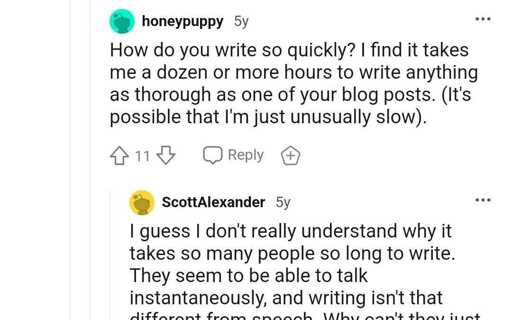
All this difference between taking 5h to write a text or writing fast has to do with one’s personal creative process. It’s impossible to generalise, to give people blanket advice about it, or to reach some meaningful conclusion out of it.
Might as well mention this here, it’s something I remembered from my uni times: “text, unlike speech, is not linear”.
When writing, earlier paragraphs can refer to later ones; you can dettach less important stuff and shuffle it around, using footnotes and glossaries and whatever; you can even hierarchise your text. If you do this while speaking your speech becomes a mess, but text enables you to do so. And a good reader will use this to retrieve your message faster and better than they would otherwise.
That multidimensionality is an amazing resource. I’m not preaching its abuse, but do use it when it fits your personal writing style. Even if it makes written language more complex — some complexity is unavoidable, when communicating.

“Write like you talk” is both unfeasible and bad advice. Don’t follow it; instead write in a way that you feel comfortable with. And if someone asks your advice on writing, read what they wrote and give them concrete and narrow criticism.
Give up the idea you can measure linguistic complexity. At most you can compare two things and say one is more complex than the other in a specific aspect; but you can’t really weight those aspects against each other. What the author is doing is a fool’s errand.
The author quotes some codemonkey called Paul Graham and his “advice” on writing. I can’t recall a single time I’ve seen a codemonkey babbling about language without making me facepalm, and even after reading Graham’s text, this stays true. (Perhaps the only insightful thing he said was about the fluff principle. Short-sighted and shallow, sure, but useful for moderators of online communities.)
In special, Graham’s “It’s also more formal and distant, which gives the reader’s attention permission to drift” is really, reeeeeeeeally bad advice. It’s good to keep some distance from your receiver; failure to do so makes you look like a pass-aggro shitlet pretending to be closer to the receiver than you actually are. The question is how to tune it, but odds are you should be keeping a bit more distance anyway. Also, you won’t avoid people drifting, be it while writing or speaking, but at least it’s easier to resume while writing.
The author is butchering Orwell’s quote by ignoring the bloody context. “Politics and the English Language”, as the title says, is about the language used by political bullshit.
All this difference between taking 5h to write a text or writing fast has to do with one’s personal creative process. It’s impossible to generalise, to give people blanket advice about it, or to reach some meaningful conclusion out of it.
Might as well mention this here, it’s something I remembered from my uni times: “text, unlike speech, is not linear”.
When writing, earlier paragraphs can refer to later ones; you can dettach less important stuff and shuffle it around, using footnotes and glossaries and whatever; you can even hierarchise your text. If you do this while speaking your speech becomes a mess, but text enables you to do so. And a good reader will use this to retrieve your message faster and better than they would otherwise.
That multidimensionality is an amazing resource. I’m not preaching its abuse, but do use it when it fits your personal writing style. Even if it makes written language more complex — some complexity is unavoidable, when communicating.