
2
Super Mario Bros. and Yoshi Games’ Affordance of Childlike Wonder and Reduced Burnout Risk in Young Adults: In-Depth Mixed Methods Cross-Sectional Study
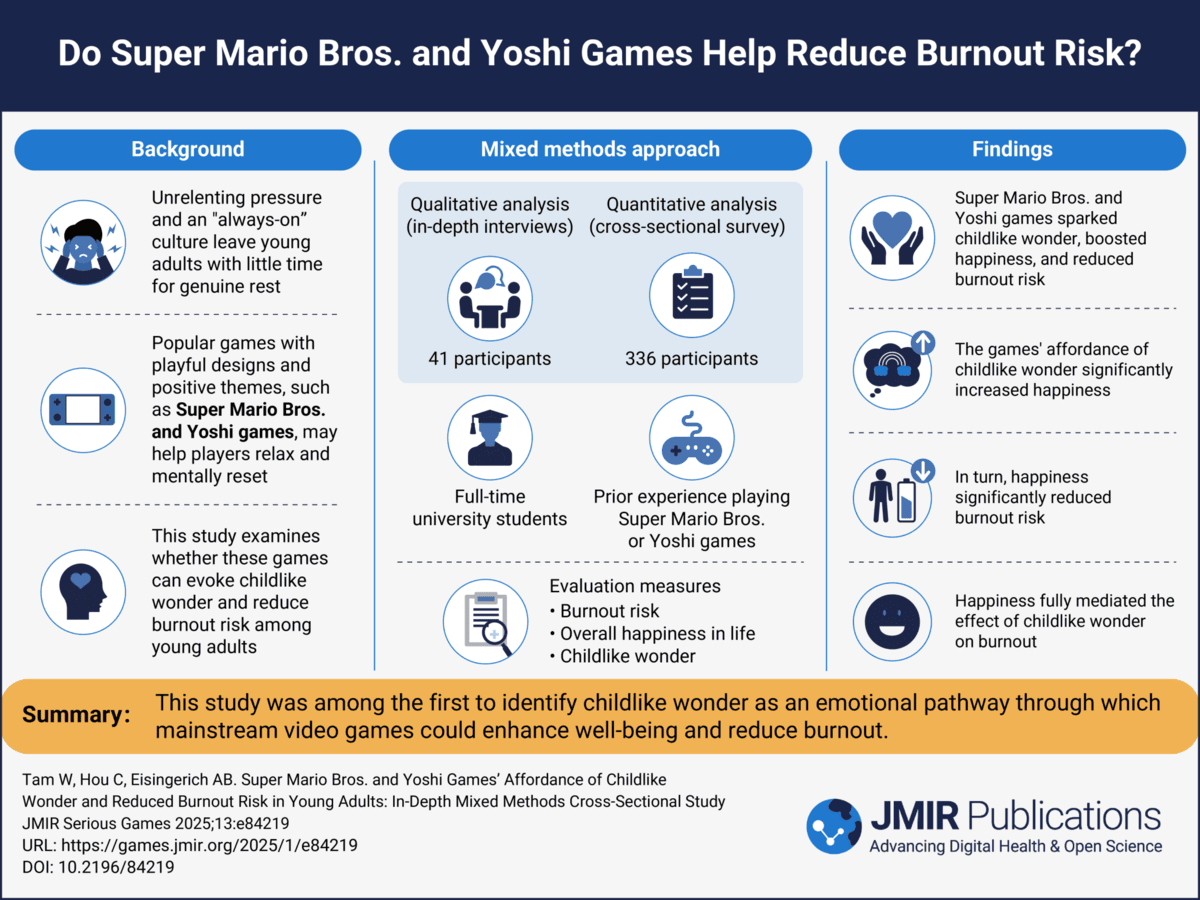
games.jmir.orgBackground: Unrelenting pressure and an “always-on” culture can leave no time for genuine rest among young adults. While playing video games has been noted to afford cognitive escapism and relaxation, critical questions remain about the influence of popular video games, such as Super Mario Bros., and their potential effects on young adults’ burnout risk.
Objective: This study examined the extent to which, if at all, popular video games such as Super Mario Bros. and Yoshi could foster childlike wonder. It also investigated the potential of these games to reduce burnout risk among young adults.
Methods: We used a mixed methods approach. First, qualitative data were collected through 41 exploratory, in-depth interviews (women: n=19, 46.3%; men: n=21, 51.2%; prefer not to disclose sex: n=11, 2.4%; mean age 22.51, SD 1.52 years) with university students who had experience playing Super Mario Bros. or Yoshi. Second, quantitative data were collected in a cross-sectional survey (N=336) of players of Super Mario Bros. and Yoshi to examine the games’ affordance of childlike wonder, overall happiness in life, and burnout risk.
Results: Insights from in-depth interviews showed that players appreciated the ability of Super Mario Bros. and Yoshi games to instill childlike wonder, enhance happiness in life, and reduce burnout risk. Quantitative analyses showed that the games’ affordance of childlike wonder positively affected young adults’ happiness (b=0.30, SE=0.04, t=6.80, 95% CI 0.21-0.38; P<.001). In turn, overall happiness significantly reduced the risk of burnout (b=–0.48, SE=0.05, t=–9.55, 95% CI –0.572 to –0.377). Results showed that happiness fully mediated the impact of childlike wonder on burnout, as the direct effect of childlike wonder on burnout risk became insignificant (b=–0.08, SE=0.04, t=–1.88, 95% CI –0.16 to 0.01; P=.06), while the indirect effect of childlike wonder on burnout risk was significant (b=–0.14, bootstrapped SE=0.03, 95% CI –0.20 to –0.09).
Conclusions: The findings showed the significant positive effect of popular video games such as Super Mario Bros. and Yoshi on fostering players’ childlike wonder, increasing happiness, and reducing burnout risk. This study was among the first to identify childlike wonder as an emotional pathway through which mainstream video games could enhance well-being and reduce burnout. By moving beyond escapism and nostalgia, it offers a new perspective on how well-designed, globally familiar games can function as accessible, resilience-building digital microenvironments. These findings contributed to research bridging gaming and mental health and have practical implications for game designers, educators, and health professionals interested in promoting mental wellness through everyday play.
Trial Registration:
You must log in or register to comment.