

- cross-posted to:
- apple_enthusiast@lemmy.world
- hackernews
- cross-posted to:
- apple_enthusiast@lemmy.world
- hackernews
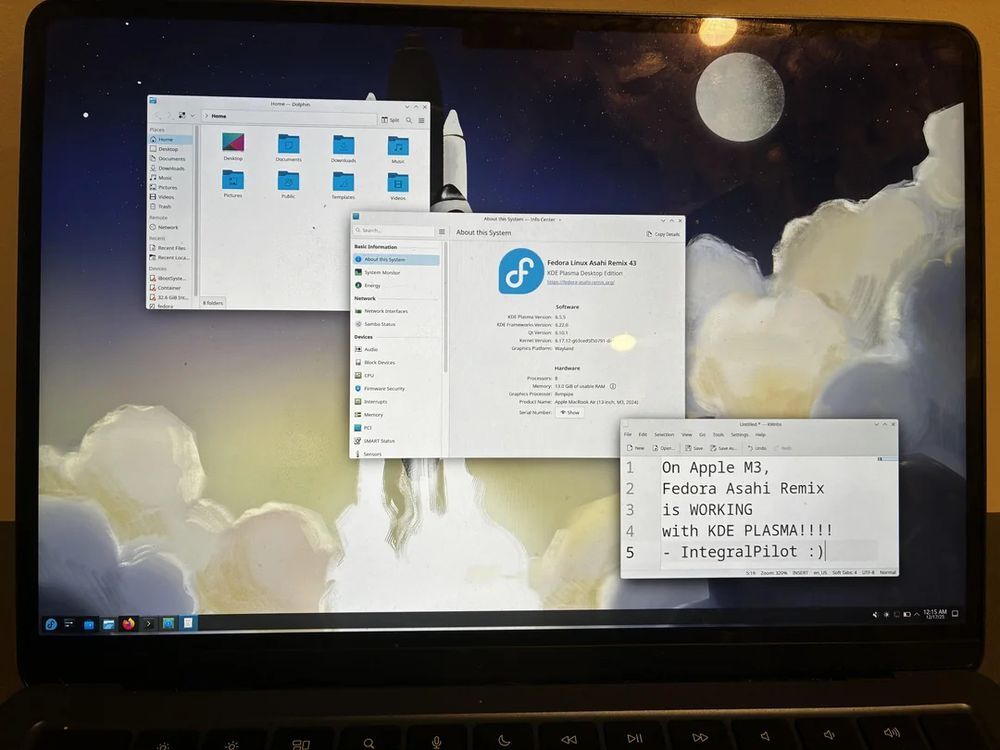
For those who do not know, asahi project until now has only worked on m1 and m2 macbooks till now (newest ones are m5). While I do not remember the technical details as to why it has not worked on m3 yet, here are official pages for support - https://asahilinux.org/fedora/#device-support and more detailed https://asahilinux.org/docs/platform/feature-support/m3/ , but the other day in some thread someone mentioned that the way asahi folks got it working was to load some vms at very early stages of boot, and that way they got stuff working, which was changed (here is link to their comment, though it mentions only m4 being the hard one, so maybe this one is not the correct reason - https://piefed.social/post/1656479#comment_9667816), but more generally, it is because apple is a closed eco system, and thy absolutely do not publish support guides for their socs. So a big achievement.
I went through 2 weeks worth of posts and there was one dead SSD. It was one of the removable ones in a 2TBT3 MBP from 2017.
The ones from your video are also all Intel laptops. Intel Macs ran so freaking hot, I’m surprised they didn’t have more failures of literally every component. The ARM ones are significantly cooler, it’s pretty hard to even get fans running on the Pro models.
There’s issues to be sure and much like you I definitely wouldn’t recommend an used Mac for running Linux, but if you can find a bargain Apple Silicon Mac and both the battery capacity and TBW values aren’t too bad, they’re pretty good, with single core performance right up there with brand new Intel or AMD CPUs in some cases, as well as excellent. Again, only if you’re willing to run a proprietary operating system. For me it’s great for work, but for most personal usage I prefer Linux, running on a desktop.
I mean dude, come on. the ref to mbpr was to illustrate the fragility of the things - did you count the busted screens that aren’t due to drops? the video was to illustrate the problem with soldered on SSDs, how apple got a multitude of different suppliers (and whose quality varies wildly) and how the TBW’s for those devices are incongruent with normal use on other platforms - and those you can simply swap out.
I’m arguing people shouldn’t buy 5-year old 8gig devices for $300+, you’re advocating for $1K+ machines that are marginally better and not even that when you consider the subject of this post, running linux on it. give it a rest already, you’re not proving anything.