
maegul (he/they)

A little bit of neuroscience and a little bit of computing

  • 10 Posts
  • 98 Comments
Joined 4 years ago
cake
Cake day: January 19th, 2023

help-circle


  • Thank you!!

    I haven’t read the essay, just your extracts.

    But I wanted to highlight the possibility of an “automation” (AI, autopilot, robots etc) that are capable of responding in the flexible ways we value about our own minds. Because it can lead to an even greater exile from our world, and personally I think its likelihood is being dangerously dismissed and ignored.

    Before any AI apocalypse scenario materialises, one in which truly intelligent automation works well could very well occur. And it would leave little to no room for human participation. A plane that doesn’t even have a cockpit, if you will. A car without a steering wheel. A tech stack that is just alien to humans. Yes, “ideally” we’d be much freer from drudgery and able to pursue happier lives. But there’d be a trade off I think, and no longer being true members of our own society seems to me the start of it.

    Thanks again for the essay!


  • Yea.

    Frankly, it may be the core of my anti-AI stance (in the short term) - that it will inevitably make technology inhospitable to humans, uninhabitable and incomprehensible too.

    I read a few reactions from security types on the barrage of security issues that came out from AI firms, earlier this year. And the overall sentiment was to lean into using AI more to keep up with AI security discoveries. To go faster and faster and ride the AI more and more.

    Which completely amounts to turning our tech over to AI and resigning as “supervisors” who won’t be able to navigate and understand the tech on their own anymore, not because of a lack of skills as many talk about, but simply because they didn’t build it and the process that did build it didn’t do it with humans in mind. Which then becomes a downward spiral with a positive feedback loop leading a mass of technology that just doesn’t need humans any more or is at least uninhabitable for us.

    It wasn’t long ago that people lamented not being able to repair their own cars, and computers too. Old fashioned maybe, but I suspect it’s a value system worth evaluating rather seriously.


  • maegul (he/they)@lemmy.mltoScience Memes@mander.xyzNot a single one
    link
    fedilink
    English
    arrow-up
    4
    arrow-down
    7
    ·
    2 months ago

    I feel like the deeper truth highlighted here is that being pro-nuclear, or anti-anti-nuclear, is very much a “reddit” style opinion.

    Whatever the actual truth is, that is. It seems to fall neatly into the “I know something and can make a ‘well actyooally’ argument about it” category without having expertise like being on top of the historical financial performance and context of the technology, about which I personally know nothing.


  • At the risk of dogpiling on a well known thing …

    I distinctly remember when I first heard the theme, watching Enterprise for the first time, and I seriously thought it was either a joke or a blatant rip off of Trek.

    I really didn’t believe it was Star Trek by the same people who’d made 90s TNG era trek. It being a prequel was part of that (like how is Star Trek about looking backwards?!). But so obviously US hokey populism was just a major turn off … as a youngster then I “knew” that’s not what Trek was. And while I was somewhat wrong (US idealism is kinda what it’s about), I think I was right in the right way.


  • Interestingly, I don’t think I share this sentiment.

    I’m no fan and personally don’t use AI (I barely touched it early ChatGPT days). But people use it to do things in successful fulfilment of their initial purpose.

    I’ve seen it. Maybe I’ve seen the successes and not the failures in some cases. And I’ve certainly seen badly failed attempts to use it, but in those cases I’m happy to ascribe the failure substantially to a misapplication of the tool (which to be fair certainly invites gross misapplication).

    My point though is that I don’t think an absolutist “AI is never useful” position is persuasive any more nor absolutely accurate.

    Which, in my view, makes addressing the “rest of the situation” all the more fundamental. Indeed, I think everything g other than its efficacy was always the important part.

    Part of the problem is that ethical arguments are difficult for people and many just switch off when it comes to the common good. Which is all of course part of the problem too.

    But I think that’s gravity of the situation right now: our collective instincts may be misaligned for the moment. Our personal habits vulnerable from our prior corruptions. And our societal architectures already mutated, perhaps beyond repair, and therefore ill equipped for this.

    Doomy, yes, but you’ve got to fight the fight you’re in, not the one you’d wish you’d won.

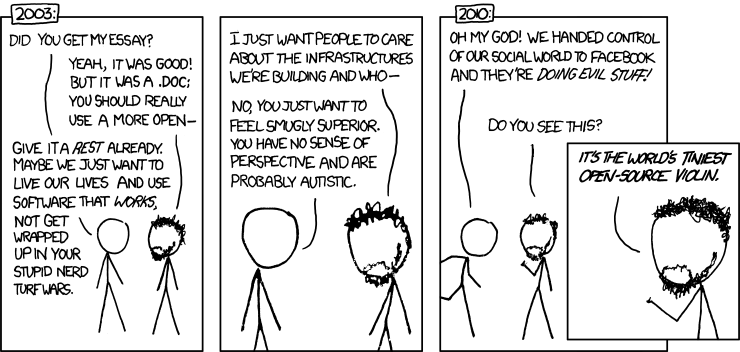
    Another way I could put this counter, is that I feel like so much of what’s bad about AI was bad before AI, and that society from 2005-2020 badly mishandled technology. Whether AI “works” or not doesn’t matter. So long as it can fit into the same shape and meet the same urges that tech did 2005-2020, it will be adopted. But if the consequences of its adoption are graver than what came before, then the whole stack of that history needs to be addressed.