A Cambridge startup is betting on plastic crystals to transform refrigeration by replacing gases with solid materials that change temperature under pressure, in a technology still under development and initially aimed at commercial systems. A startup affiliated with the University of Cambridge is working on a refrigeration technology that exchanges gases for solid materials capable […]


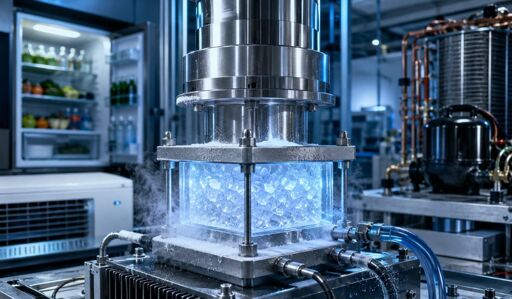
Plastic as in plastic deformation, not plastic as in milk jugs. The crystals have a weak molecular bond so can squash and deform.
Even if they are literally plastics, probably way better* for the environment than the gasses used in refrigeration; and miles better than Freon.
*Assuming it works as efficiently
Also some plastics are made renewably and/or are biodegradable. It’s a broad range of materials.
plasticity
Except, what they’re describing seems to be elastic, not plastic. Plastic deformation is permenant.
I won’t profess to be an expert but I think they’re often compared to wax for how easy they can be to deform which falls more under plastic deformation.
Its not deforming at all though. Its compressing and decompressing, like a spring. Plastic is plastic, elastic is elastic. You can’t say “this plastic is elastic”, its a different property altogether.
It’s been a long time since I took material science, but if memory serves, the terms “plastic deformation” and “elastic deformation” are applicable to any number of materials. Metal alloys have a range of “elastic deformation” as well as “plastic deformation”. Plastics and elastics also have those ranges. It’s unintuitive in everyday parlance, but it wouldn’t be inaccurate in the mechanical sense to say “this plastic is elastic” because plastics do have ranges where their deformations are defined as elastic.
I had to study properties of metal for an engineering class. There was no elastic deformation that I remember, unless you pass the materials elastic limit. Important concepts to be clear about. You don’t want something plastic if you need elastic.
The way I recall it being taught was that “elastic deformation” was deformation that didn’t compromise the integrity of the original shape of the object (typically a rigid body in most of my textbook’s examples, which could be where our understandings are deviating).
One example my professor used to illustrate the concept in-person was with a paper clip. Bending one end the paper clip ever so slightly (such that it springs back into its original shape when you let go) was “elastic deformation” of the material. Bending the end of the paper clip enough such that it can’t return to its original shape afterward was “plastic deformation”.
And plastic deformation can’t be reversed, its a one-shot deal, when its bent its bent. Loses integrity as well when its deformed.
Take it up with Jean Timmerman and the Cambridge professor starting the company you don’t like their naming
Plastic and elastic deformation are both terms used to refer to the behavior of a material under stress (such as compression, tension, or torsion).
For an ELI5 since I don’t feel like cracking open a material science textbook or really getting more nuanced than this for a basic explanation, elastic deformation is generally reversible without permanent changes to the structure of the material, while plastic deformation imparts a permanent change.
All materials have elastic and plastic deformation modes that can be identified based on their characteristic stress-strain curve. Generally, the linear portion of the curve at lower stresses is the elastic region, and the plastic region begins where the curve becomes nonlinear.
For example, a wooden beam in a house will bend under normal load. As people move out of the room that beam is in, it will straighten back out- that is elastic deformation. Put too many people or some very heavy furniture in the room, though, and the beam will become permanently bent or even break altogether- that is a plastic deformation.
Some solid books on this topic are Shingley’s Mechanical Engineering Design and Roark’s Formulas for Stress and Strain
The colloquial use of elastic and plastic to describe certain groups of materials is based off the behaviors of these modes of deformation. E.g. elastics are stretchy and return to their original shape. If you really want to get into semantics, there are only four types of materials: metals, polymers, ceramics, and composites. Everything else is one of those 4 things.
I think that’s sort of the trick. They do the plastic deformation “permanently” into one shape, then they “permanently” deform it back. I assume there’s some crystal lattice stuff going on that makes one of the deformations require more/less energy than the other deformation, and thus the heat created doesn’t quite balance, meaning you can now theoretically transfer heat energy with it.