Microplastics leak everywhere.
I feel like I can hear the Technology Connections guy take a deeeeep inhale and a long exhale.
angry Midwestern noises
oh look another bullshit startup intended only to appear game changing long enough to enrich some greedy founders. im sure this will fundamentally change the world of heat pumps for the better. totally.
Barocalorics is a really important field right now. I don’t actually think this category of tech is bullshit based on the core research I’ve been following.
Maybe this particular startup is, but the field is actually ready for a breakthrough. We need startups to take the risk of doing an initial manufacturing run or nothing will ever happen.
This is the breakthrough. Now they need to prove it as a product and scale it up for manufacturing.
Doesn’t squeezing add energy to a system? In other words, make it hotter. My tiny brain can’t break rules of thermodynamics.
Yes. You are always adding net energy to the system. That’s why a heater is a self-contained unit (turns energy into heat) while an air conditioner requires two units- one to suck up the heat outside, another to reject that heat outside. It’s not ‘creating cold’, it’s using energy to pump heat from the inside to the outside. The total amount of heat rejected outside is a net addition- it’s the heat sucked up from inside, plus the waste heat from the compressor.
The air conditioner (current design) works on the simple principle that the boiling point of a liquid changes based on ambient pressure, and that phase change (between liquid and gas) carries a lot of latent energy. To boil water with heat alone, it takes about 100 calories to heat a gram of water from just above freezing to just below boiling. But to boil it, to heat it less than one more degree and turn it into gas, takes another 433 calories. That means if you adjust its boiling point by pressurizing and depressurizing it, whenever it boils or condenses it’ll suck up or release a lot of heat at the same time.
Obviously we want colder than 100c, so we use a refrigerant like tetrafluoroethane with a boiling point of -26c.
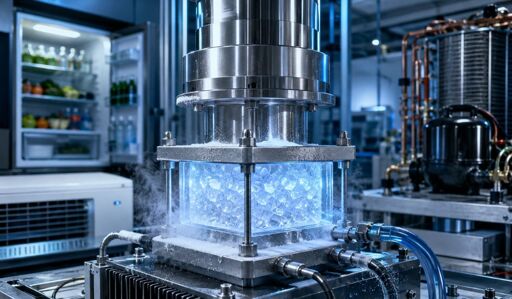
This gadget uses a similar concept. Instead of using pressure to tweak the boiling point of a refrigerant, it uses a solid that heats or cools in response to pressure. Then water carries the heat around.
Squeezing (pressurizing) certain gases are basically how air conditioners work. Under pressure, the gases can absorb more heat (think pressure cooker - those get hotter because they raise the boiling point of water with the higher pressure). Shuffle that pressurized gas somewhere else with lower pressure, and it can no longer hold all that heat and needs to release it. Tada: heat has been moved from one location to another.
OK, that sounds nice, but until it’s a commercially available product, I won’t hold my breath
Very interesting stuff.
Great more microplastics to add to the already fucking problem.
Plastic as in plastic deformation, not plastic as in milk jugs. The crystals have a weak molecular bond so can squash and deform.
Even if they are literally plastics, probably way better* for the environment than the gasses used in refrigeration; and miles better than Freon.
*Assuming it works as efficiently
Also some plastics are made renewably and/or are biodegradable. It’s a broad range of materials.
plasticity
Except, what they’re describing seems to be elastic, not plastic. Plastic deformation is permenant.
I won’t profess to be an expert but I think they’re often compared to wax for how easy they can be to deform which falls more under plastic deformation.
Its not deforming at all though. Its compressing and decompressing, like a spring. Plastic is plastic, elastic is elastic. You can’t say “this plastic is elastic”, its a different property altogether.
It’s been a long time since I took material science, but if memory serves, the terms “plastic deformation” and “elastic deformation” are applicable to any number of materials. Metal alloys have a range of “elastic deformation” as well as “plastic deformation”. Plastics and elastics also have those ranges. It’s unintuitive in everyday parlance, but it wouldn’t be inaccurate in the mechanical sense to say “this plastic is elastic” because plastics do have ranges where their deformations are defined as elastic.
I had to study properties of metal for an engineering class. There was no elastic deformation that I remember, unless you pass the materials elastic limit. Important concepts to be clear about. You don’t want something plastic if you need elastic.
The way I recall it being taught was that “elastic deformation” was deformation that didn’t compromise the integrity of the original shape of the object (typically a rigid body in most of my textbook’s examples, which could be where our understandings are deviating).
One example my professor used to illustrate the concept in-person was with a paper clip. Bending one end the paper clip ever so slightly (such that it springs back into its original shape when you let go) was “elastic deformation” of the material. Bending the end of the paper clip enough such that it can’t return to its original shape afterward was “plastic deformation”.
Take it up with Jean Timmerman and the Cambridge professor starting the company you don’t like their naming
Plastic and elastic deformation are both terms used to refer to the behavior of a material under stress (such as compression, tension, or torsion).
For an ELI5 since I don’t feel like cracking open a material science textbook or really getting more nuanced than this for a basic explanation, elastic deformation is generally reversible without permanent changes to the structure of the material, while plastic deformation imparts a permanent change.
All materials have elastic and plastic deformation modes that can be identified based on their characteristic stress-strain curve. Generally, the linear portion of the curve at lower stresses is the elastic region, and the plastic region begins where the curve becomes nonlinear.
For example, a wooden beam in a house will bend under normal load. As people move out of the room that beam is in, it will straighten back out- that is elastic deformation. Put too many people or some very heavy furniture in the room, though, and the beam will become permanently bent or even break altogether- that is a plastic deformation.
Some solid books on this topic are Shingley’s Mechanical Engineering Design and Roark’s Formulas for Stress and Strain
The colloquial use of elastic and plastic to describe certain groups of materials is based off the behaviors of these modes of deformation. E.g. elastics are stretchy and return to their original shape. If you really want to get into semantics, there are only four types of materials: metals, polymers, ceramics, and composites. Everything else is one of those 4 things.
I think that’s sort of the trick. They do the plastic deformation “permanently” into one shape, then they “permanently” deform it back. I assume there’s some crystal lattice stuff going on that makes one of the deformations require more/less energy than the other deformation, and thus the heat created doesn’t quite balance, meaning you can now theoretically transfer heat energy with it.
Not until it’s a real thing that actually exists. As of now, it’s just some imaginary bullshit to get investors excited…
Cools when squeezed? Yes, I do.
Isn’t this already a thing to some degree with sodium acetate pads?
That’s a phase change triggered by a seed crystal (generated from a physical shock from the ‘clicker’) where the transition from liquid to solid phases returns the latent heat that was previously added to turn it from solid to liquid.
There is no phase change in this material, it remains a solid and changes temperature depending on how much pressure is applied to it.