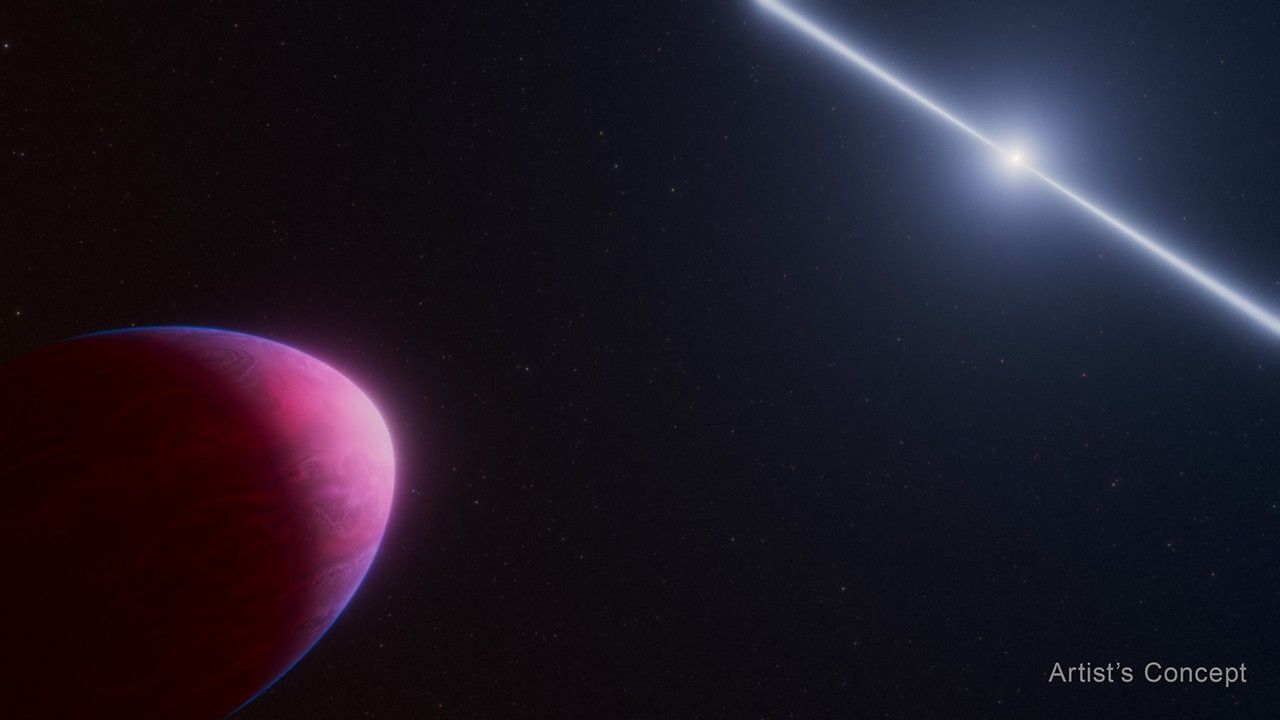
Scientists using NASA’s James Webb Space Telescope have observed a rare type of exoplanet, or planet outside our solar system, whose atmospheric composition
follow up question. light gasses tend to abandon the atmosphere first,. unless it’s a cold planet or it hasna strong gravity. wouldn’t the conditions for helium to remain in the atmosphere be mutually exclusive with those extreme conditions to have carbon in the atmosphere?
Gravitational forces from the much heavier pulsar are pulling the Jupiter-mass planet into a bizarre lemon shape.
A Jupiter-mass planet is considered pretty damn big with an incredibly strong gravitational field. Planets that are about 13 times bigger than Jupiter are considered brown dwarves which are just a few steps away from being full on stars.
I’m not going to look at the temperatures and escape velocities of gasses. just that helium atmosphere and carbon atmosphere are on the polar opposite of atmospheres. maybe there’s something exotic going on (not magic), like a cold (ish, it’s a heavy planet, I mean not extrememly hot) helium atmosphere with a ring of carbon dust affecting the spectrometry.
I’m not doubting the discovery. I’m assuming it’s spectrography and it is true, it’s just crazy how insane the universe is. whenever I assume nothing new will surprise me, we find out something new.

follow up question. light gasses tend to abandon the atmosphere first,. unless it’s a cold planet or it hasna strong gravity. wouldn’t the conditions for helium to remain in the atmosphere be mutually exclusive with those extreme conditions to have carbon in the atmosphere?
A Jupiter-mass planet is considered pretty damn big with an incredibly strong gravitational field. Planets that are about 13 times bigger than Jupiter are considered brown dwarves which are just a few steps away from being full on stars.
I’m not going to look at the temperatures and escape velocities of gasses. just that helium atmosphere and carbon atmosphere are on the polar opposite of atmospheres. maybe there’s something exotic going on (not magic), like a cold (ish, it’s a heavy planet, I mean not extrememly hot) helium atmosphere with a ring of carbon dust affecting the spectrometry.
I’m not doubting the discovery. I’m assuming it’s spectrography and it is true, it’s just crazy how insane the universe is. whenever I assume nothing new will surprise me, we find out something new.