I kind of agree, but Country, really? They know most services can be used outside the US? A great way would be to choose a country (okay, if the majority of users are from the US it can be preselected), then that country’s postal code list is used to fill in the rest of the fields (and as a fallback, you can enter unlosted code and address).
I still remember some asshole American services telling me that “a postal code consists of 5 numbers” (I’m from Europe, and it’s 6 everywhere) - this is the result of going crazy on assumptions. Nice and convenient standardized systems can be built, but if you make one for an address on the planet, then start from Country and down, not from “I watched Beverly Hills 90210, this seems to work for me”
Canada is 3 letters and 3 numbers, alternated.
For example, Santa’s postal code is H0H 0H0 (this is real btw, he will answer in any language and the postage is free)
Yeah, which is also the explanation why this isn’t implementented nearly as often as the author would like.
The folks implementing these address input components probably puke already from just needing different sets of input fields and formats for different countries. If they have to call different APIs with different input and output formats for every country, that increases complexity quite a bit.
You didn’t offend me but your comment is completely useless. Ok, you corrected me, allegedly not all of European countries use 6-digit codes. But how does it add to the discussion?
That a check “if EU then 6 digits” would also be wrong. You should allow the user to put whatever they want as the zip code (ofc with some sane limit of max chars).
Read my comment. Where do I imply I will take 6 digits? I wrote: choose country, then enter that country’s postcode in order the other data to be fetched. And I even wrote about a fallback (for the case there is no postcode/address data for that country, so we just allow the user to enter whatever they want).
I agree they probably should’ve addressed that in the main post, but at least it’s in the caveats below:
Fine, maybe country first. The purists in the comments are technically correct — postal codes aren’t globally unique. You could do country first (pre-filled via IP), then postal code, then let the magic happen. The point was never “skip the country field.” The point is: stop making me type things you already know.
This makes sense. I’m of course not against the very idea. It’s just from the main text it looks like they plan to be systematic, and then immediately jump to step 2/5/… :)

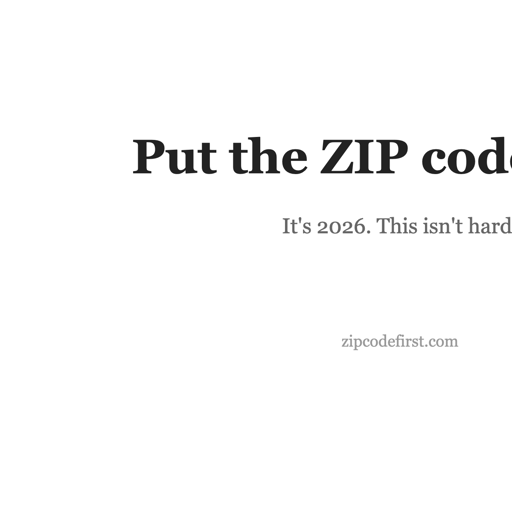
I kind of agree, but Country, really? They know most services can be used outside the US? A great way would be to choose a country (okay, if the majority of users are from the US it can be preselected), then that country’s postal code list is used to fill in the rest of the fields (and as a fallback, you can enter unlosted code and address).
I still remember some asshole American services telling me that “a postal code consists of 5 numbers” (I’m from Europe, and it’s 6 everywhere) - this is the result of going crazy on assumptions. Nice and convenient standardized systems can be built, but if you make one for an address on the planet, then start from Country and down, not from “I watched Beverly Hills 90210, this seems to work for me”
Canada is 3 letters and 3 numbers, alternated. For example, Santa’s postal code is H0H 0H0 (this is real btw, he will answer in any language and the postage is free)
Yeah, which is also the explanation why this isn’t implementented nearly as often as the author would like.
The folks implementing these address input components probably puke already from just needing different sets of input fields and formats for different countries. If they have to call different APIs with different input and output formats for every country, that increases complexity quite a bit.
it’s not 6 everywhere in Europe
Ok, thank you for your input, it matters a lot in the context of the conversation.
your reply seems sarcastic, did I offend you?
You didn’t offend me but your comment is completely useless. Ok, you corrected me, allegedly not all of European countries use 6-digit codes. But how does it add to the discussion?
That a check “if EU then 6 digits” would also be wrong. You should allow the user to put whatever they want as the zip code (ofc with some sane limit of max chars).
Read my comment. Where do I imply I will take 6 digits? I wrote: choose country, then enter that country’s postcode in order the other data to be fetched. And I even wrote about a fallback (for the case there is no postcode/address data for that country, so we just allow the user to enter whatever they want).
I agree they probably should’ve addressed that in the main post, but at least it’s in the caveats below:
This makes sense. I’m of course not against the very idea. It’s just from the main text it looks like they plan to be systematic, and then immediately jump to step 2/5/… :)
They talk about that in the blog
This blog assumes a lot. It’s very US centric.