I know Z as upward. X and Y were always on the base plane representing length and width. Z comes in being all like, “Now we’re being 3D!”
So wherever the “floor” is, represented with gridlines, boundary, canvas, etc. that’s where they live. That is Flatland where there is no up or down. It is 2D where most of my work is. If you try tell me Y is Z, I’d ask “wtf is a Z?”
You’re mixing up perspective with the object’s actual coordinates system. The “left-right-up-down” are your perspective or computer screen and do not define the axes of the object itself. The object has its own.
If I rotate a map on a table, it’s X and Y don’t suddenly flip. The coordinates belong to the object, I’m just viewing them from a different perspective now.
In mathematics, the Z axis only exists because it’s defined as being perpendicular to an existing plane (the plane X and Y form). The gridlines represent that plane and Z’s extrusion values reference it. Your perspective or viewing angle don’t influence these coordinates at all.
Commonly we face the XY plane down as it’s “floor”. We build things from the ground up. We draw from top down. It’s just how gravity brought the standard around. You can flip it however you want, though. But if you see a grid, that’s a plane and Z is extrusion off that.
No. That is not my logic. It’s the logic of Rene Descartes who invented the thing you are trying to talk about.
And because gaslighting attempts online are hilarious, I’ll assume you just didn’t read so good and will repeat myself again; we tend to rest the plane on the floor, as it is in our reality with gravity it is easier to conceive. Like modelling a car, it’s wheels on the screen spend most of the time pointed down.
You don’t have to. You can model it any direction you want, but most people find it easy in an orientation that mimics common perspective. But however you do it, you still can’t have a Z axis without a plane. That’s the point. Grid is plane and plane is needed for Z. If you have a grid on Z it’s representing an infinitely possible slice through extrusion and that’s basically a concept behind some fractals, which introduces a new vector for new XYZ points within.
I know you really want to be right but this is very long-standing foundational and basic stuff we just do. It isn’t my logic or opinion, I’m sharing this knowledge to you, something you can very easily look up yourself right now and forget I even exist—which would be neat.
But what if instead of adding a third dimension by going UP, you add a third dimension by going FORWARD. Like a computer screen, X and Y coordinates are side-to-side and up-and-down. If you made a volumetric display by adding a third dimension to that, Y would be up and Z would be forward.
I usually think of Z as up, because that’s how stuff based on the physical world usually works. But I can understand why some think of it with Y as up.
Third dimension isn’t up, it’s just not X or Y. We just say “height” or synonyms for it because we say “length and width” for X and Y, even though all axis are just length between vectors proceeding in order of being able to exist, X, Y, then Z.
If you are plotting your perspective, it will run on entirely different coordinates to an object’s coordinates, i.e. Camera vs Object stricture. But in most arts and all math, we tend to model the object and it’s values which we create and assign to it as attributes, not with values of how it should look from various perspectives.
I think that’s the confusion. You could get used to the Z being treated as Y, but it’s incomparable with everything else and you’d have to now confirm with other’s that length and width are X and Z and extrusions from 2D plane are Y. This doesn’t occur much anywhere else. This is the whole premise behind the meme. Arguing between standards when one is universal, the other is niche but those that have only learned the niche one are adamant the universal one is wrong.


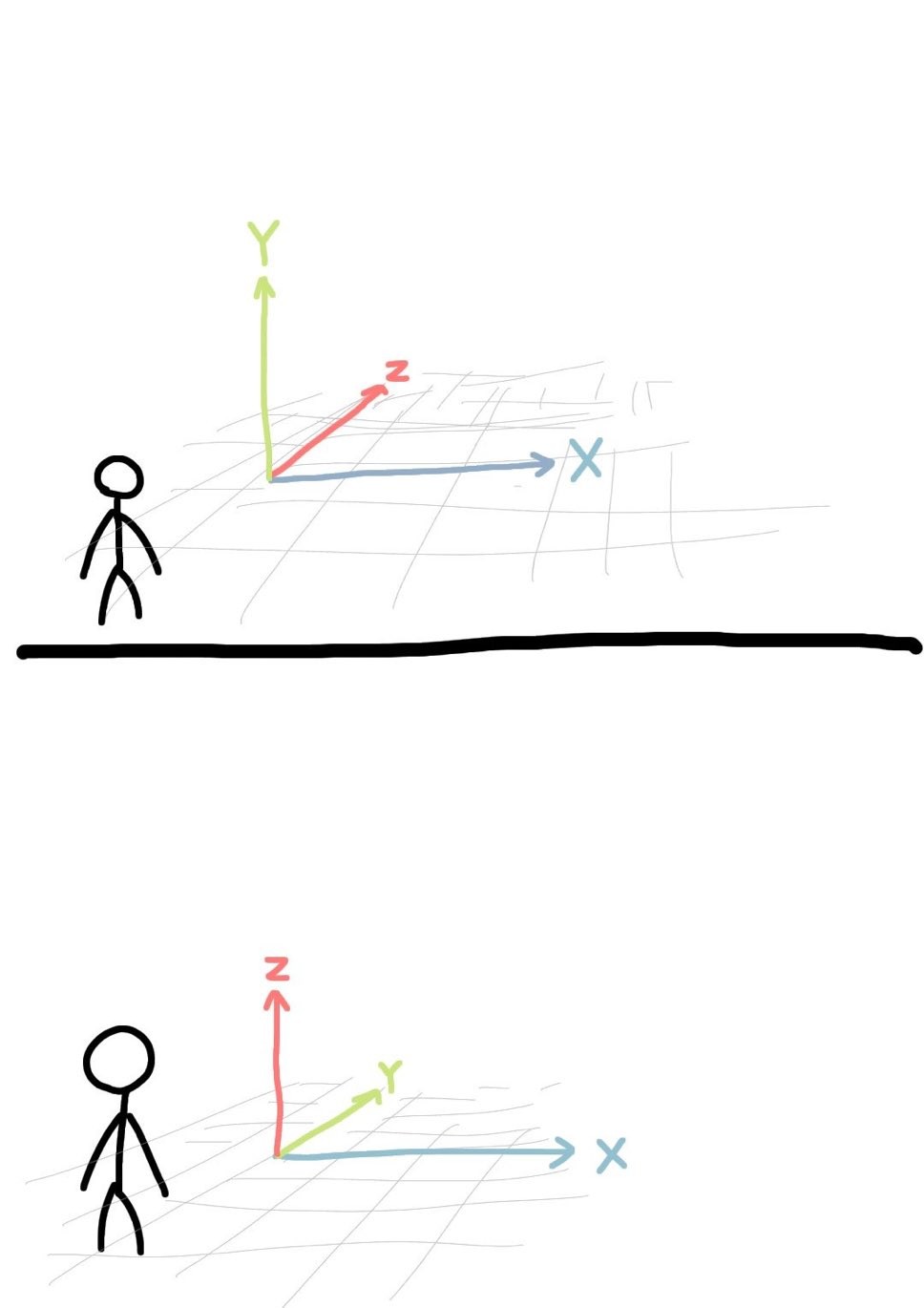
I know Z as upward. X and Y were always on the base plane representing length and width. Z comes in being all like, “Now we’re being 3D!”
So wherever the “floor” is, represented with gridlines, boundary, canvas, etc. that’s where they live. That is Flatland where there is no up or down. It is 2D where most of my work is. If you try tell me Y is Z, I’d ask “wtf is a Z?”
deleted by creator
You’re mixing up perspective with the object’s actual coordinates system. The “left-right-up-down” are your perspective or computer screen and do not define the axes of the object itself. The object has its own.
If I rotate a map on a table, it’s X and Y don’t suddenly flip. The coordinates belong to the object, I’m just viewing them from a different perspective now.
In mathematics, the Z axis only exists because it’s defined as being perpendicular to an existing plane (the plane X and Y form). The gridlines represent that plane and Z’s extrusion values reference it. Your perspective or viewing angle don’t influence these coordinates at all.
Commonly we face the XY plane down as it’s “floor”. We build things from the ground up. We draw from top down. It’s just how gravity brought the standard around. You can flip it however you want, though. But if you see a grid, that’s a plane and Z is extrusion off that.
deleted by creator
No. That is not my logic. It’s the logic of Rene Descartes who invented the thing you are trying to talk about.
And because gaslighting attempts online are hilarious, I’ll assume you just didn’t read so good and will repeat myself again; we tend to rest the plane on the floor, as it is in our reality with gravity it is easier to conceive. Like modelling a car, it’s wheels on the screen spend most of the time pointed down.
You don’t have to. You can model it any direction you want, but most people find it easy in an orientation that mimics common perspective. But however you do it, you still can’t have a Z axis without a plane. That’s the point. Grid is plane and plane is needed for Z. If you have a grid on Z it’s representing an infinitely possible slice through extrusion and that’s basically a concept behind some fractals, which introduces a new vector for new XYZ points within.
I know you really want to be right but this is very long-standing foundational and basic stuff we just do. It isn’t my logic or opinion, I’m sharing this knowledge to you, something you can very easily look up yourself right now and forget I even exist—which would be neat.
deleted by creator
But what if instead of adding a third dimension by going UP, you add a third dimension by going FORWARD. Like a computer screen, X and Y coordinates are side-to-side and up-and-down. If you made a volumetric display by adding a third dimension to that, Y would be up and Z would be forward.
I usually think of Z as up, because that’s how stuff based on the physical world usually works. But I can understand why some think of it with Y as up.
Third dimension isn’t up, it’s just not X or Y. We just say “height” or synonyms for it because we say “length and width” for X and Y, even though all axis are just length between vectors proceeding in order of being able to exist, X, Y, then Z.
If you are plotting your perspective, it will run on entirely different coordinates to an object’s coordinates, i.e. Camera vs Object stricture. But in most arts and all math, we tend to model the object and it’s values which we create and assign to it as attributes, not with values of how it should look from various perspectives.
I think that’s the confusion. You could get used to the Z being treated as Y, but it’s incomparable with everything else and you’d have to now confirm with other’s that length and width are X and Z and extrusions from 2D plane are Y. This doesn’t occur much anywhere else. This is the whole premise behind the meme. Arguing between standards when one is universal, the other is niche but those that have only learned the niche one are adamant the universal one is wrong.