

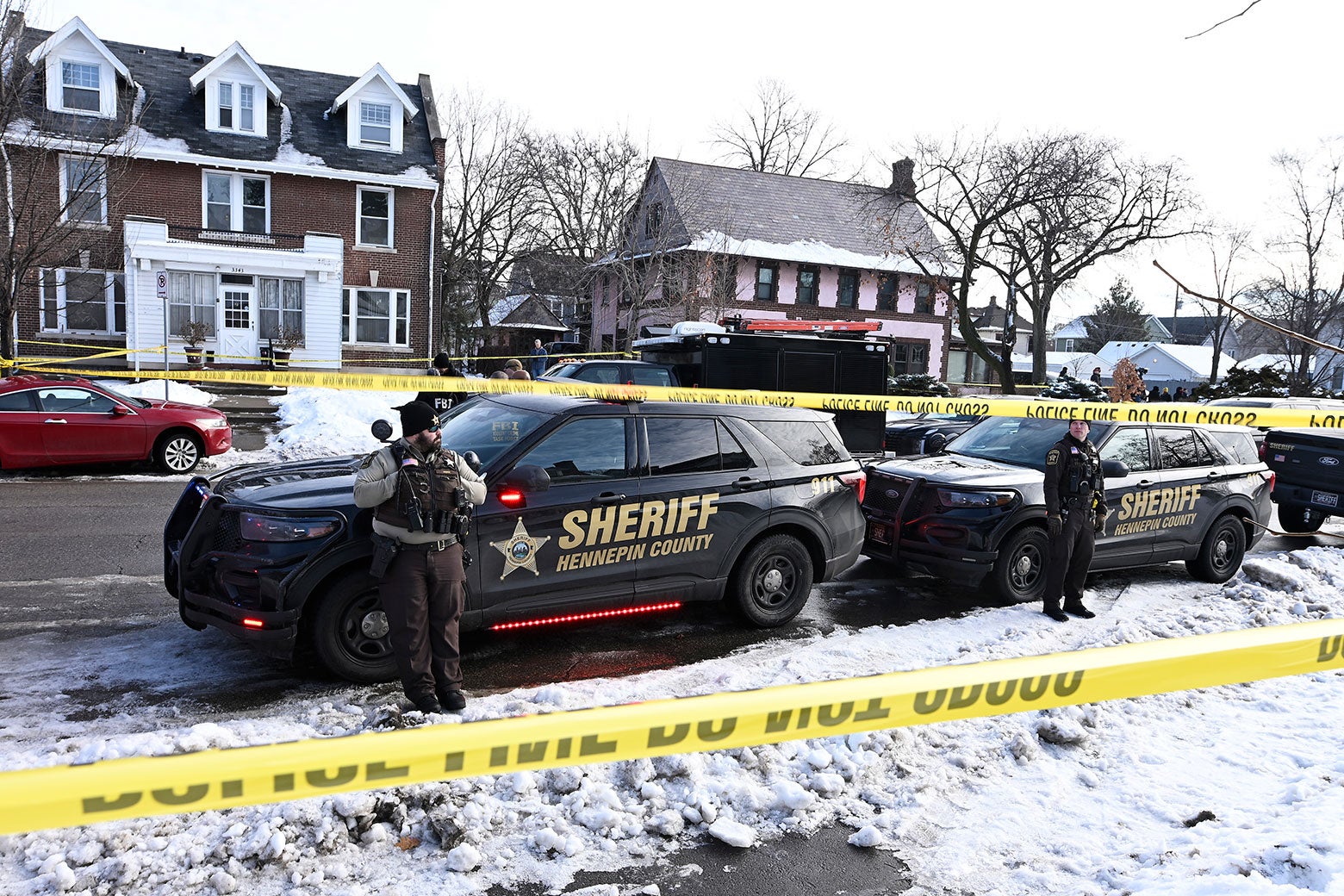
Shortly after a U.S. Immigration and Customs Enforcement officer shot and killed a woman in Minneapolis on Wednesday, city leaders began looking into whether the officer had violated state criminal law.
Minneapolis Mayor Jacob Frey said, “We collectively are going to do everything possible to get to the bottom of this, to get justice, and to make sure that there is an investigation that is conducted in full.” Police Chief Brian O’Hara followed up by saying that the state’s Bureau of Criminal Apprehension is “investigat[ing] whether any state laws within the state of Minnesota have been violated.”
If they conclude that state law has been violated, the question is: What next? Contrary to recent assertions from some federal officials, states can prosecute federal officers for violating state criminal laws, and there is precedent for that.
Well, the law says he doesn’t have to be in danger to shoot, he just has to think he’s in danger. It would be impossible to convict him because he’s innocent.
So if you throw a paranoid individual into a daycare, they can legally kill a bunch of kids because they think they are in danger?
No. The “reasonable person” standard is applied. Would a reasonable person in the position of the imperiled person believe they faced a credible, criminal, imminent, threat of death or grievous bodily harm? If so, anyone present may use any level of force that a reasonable person would believe necessary to stop that threat.
Even if we give him the benefit of an unreasonable doubt and say he was sufficientlt imperiled, “Necessary” is what is going to hang this guy: the level of “force” “necessary” to end the “imminent threat” was to take a half-step to the right. “Sidestep-Right” is the extent of the force he was justified in using against her here.
A reasonable person knows how cars work. They go in the direction the wheels are pointed at. Her wheels were pointed away from the officer, towards an escape path. The mofo was just dying for a chance to shoot someone
I agree completely.
The jury owes him the benefit of a reasonable doubt. For purposes of discussion, I contemplated a scenario where we extended that doubt beyond reasonable, and into the realm of the unreasonable. Even if his unreasonable belief of danger was somehow deemed acceptable, it would only justify a level of “force” necessary to stop that danger. Even if he were actually in danger, moving slightly to his right is all he was justified in doing under self defense law.
Her car wheels drove directly over the ground where he was. He was literally hit as he got out of the way. He would’ve been seriously injured if he didn’t move.
He walked in front of a vehicle being directed to move by the other masked assailants.
He would have been fine had he not walked in front of a moving vehicle.
As you stated, he would have a been seriously injured if he didn’t move. moving out of the way is the only needed action. When does stopping and killing come in to play again?
A reasonable person would understand that a vehicle doesn’t magically come to a stop if the driver loses control of it (e.g. by being murdered), and would instead GTFO of the way rather than using that time to draw, aim, and fire a weapon.
In fact, the video even shows the vehicle crashing after said loss of control.
So police are never supposed to shoot at cars trying to run them over because the car would keep driving for a bit anyways? Good luck in court with that one…
I don’t think that follows from their argument. It’s valid for this particular case. It would not be valid in a scenario where the driver was reacting to the officer’s evasion attempts by steering toward them.
Aye, there may be some limited circumstances where the it might actually make sense. This event in MN ain’t it.
It’s an ineffective strategy, so it’s illogical to do so anyhow. Anyone with even basic grasp of physics should understand this. I suppose this is where the dumbing down of the American education system has gotten us.
Even DHS guidelines say as much. This agent violated these guidelines.
I wouldn’t be the one defending myself in court from murder charges, so I’m not the one in need of luck. Good luck on the shooter convincing me (e.g. as a jury member) that the shooting was justified.
Any they police? Are these American children with toy guns? If yes to either, then daycare is out. Forever.
Don’t be silly, it only applies to cops
Yes, he would be not guilty by reason of insanity. You can’t hold mentally ill people responsible for what they did during a psychotic episode. I mean, you shouldn’t, in US he would probably still end up in jail. Because US doesn’t have a functional mental health system.
I don’t know why you’re downvoted. You’re essentially correct and this justification has been used by LEO on many occiasions. All they have to do is claim they felt or saw something that made them believe their life was in danger - even if that threat was them deliberately placing themselves in front of a vehicle and refusing to step aside when it was apparent the vehicle was headed toward them with plenty of warning at worst a shin bruising speed. This is how we get people shot who are unarmed, or already on the ground, or acorns hitting car roofs.
However, he’s not innocent. Not at all. It will be impossible to convict because the legal system is full of boot lickers or scared of the police, and trump toadies will intervene.
I mean yeah, it’s not that he’s innocent, it’s more that it would be impossible to prove he’s guilty because to prove that you would have to somehow show what he was thinking in that specific moment. It’s no just some justification. It’s how the law is constructed. In a normal country you would require police to act with accordance to their training and if they panic and fuck up they are responsible. In US if a cop fucks up it’s ok, it’s not his fault.
And people are downvoting because they don’t like the law, not because they don’t like my comment. Each downvote is tiny protest against police brutality in US. Keep them coming!
This is a fundamental misunderstanding of the construction of the law. As designed, it doesn’t matter what the individual was thinking. It matters what a hypothetical “reasonable person” would be thinking or doing in the circumstance. It’d be up to the finder of fact to determine if the actions were reasonable (though, here, depending on charges, it might be “reasonable officer”).
There are also potential wrinkles like qualified immunity, but that might be hard to prove in a basically unprovoked killing like this. Additionally, the broad leeway afforded to police might not be there in this case since the State would actually be seeking a conviction and other courts have openly started not giving ICE the benefit of the doubt.
But the key takeaway here is that it’s less important what this murderer was thinking when he did the murder and more important whether a “reasonable person/officer/[whatever]” would have been justified in taking those actions.
That’s not as important distinction as you think. The important part is that it’s based on the perception of the officer, not on actual situation. You can’t say that because when looking at the video it doesn’t look like he was in danger so the shooting was not justified. If he claims that from his perspective it looked like he was in danger it will be pretty much impossible to prove it was unreasonable. The moves to goalpost so high cops are only convicted when the shoot someone sitting on a couch eating ice cream or lying on the ground not moving and even then it’s not guaranteed. I
This is not the legal standard at all. It is very specifically not based on the perception of the officer. It’s based on whether a hypothetical reasonable person would have taken those same actions.
The ICE officer probably won’t testify or share their feelings. And if they do, the standard is still based solely on their actions viewed through the lens of this hypothetical reasonable person. The defense will argue that they justifiably feared for their life (or whatever their statutory standard is), but the officer’s claimed perceptions are irrelevant.
Imagine an insane cop shoots someone because they think they’re a space alien trying to probe them, but it’s actually just some guy trying to stab the cop. The reasonable person standard means you’d assess the shooting based on the supposed actions of a reasonable person. Would a reasonable person have shot them? Probably. So, even if a shooter is motivated by the delusional belief that their target is a “space alien” intent on probing them, the act is legally justified if the target was posing an actual, objective threat—such as an attempted stabbing. Because a “reasonable person” would use force to stop a knife attack, the shooter’s bizarre motivation does not negate the fact that the use of force was objectively necessary. In this case, the subjective fear of the officer is irrelevant if the act was objectively unreasonable.
And, yeah, of course the courts bend over backwards to suck cops’ dicks and they get away with murder all the time. But, honestly, how many cops are even criminally charged? At trial, in front of a jury, it’s harder to prove. We just usually don’t see indictments and when we do, often important evidence is excluded in favor of law enforcement.
This is exactly the legal standard in Minnesota: https://www.revisor.mn.gov/statutes/cite/609.066
“the decision by a peace officer to use deadly force shall be evaluated from the perspective of a reasonable officer in the same situation, based on the totality of the circumstances known to or perceived by the officer at the time, rather than with the benefit of hindsight, and that the totality of the circumstances shall account for occasions when officers may be forced to make quick judgments about using deadly force”
The insane cop shooting space alien is some nonsense example. It specifically says that the officer takes decision based on what he “perceives”. Notice that it also mentions “quick judgments” but it doesn’t say anything about training. So a cop doesn’t have to follow any protocol (like don’t get in front of a moving car to stop it) but is basically acting on the spot, based on what he sees and how he interprets it in the moment. This is insanely low legal standard and proving that cop broke this law is pretty much impossible. In this specific case, to get a conviction, you would need 12 partisan jurors that ignore the evidence and convict him in protest, some sort of reverse jury nullification basically.
And of course I’m not saying that the cop was right here. I think this psycho intentionally put himself in front of the car to kill this women. My point is you can’t prove if he did it intentionally or not and the law doesn’t say that if he does something stupid the shooting is not justified. And yes, we can spend hours arguing if it’s reasonable to think this car would run him over and if this goes to court that’s what they will do there. I think, based on many other cases of police shootings that went to court, that there’s 0% chance jury will agree it was not reasonable and convict him.
First, disclaimer, I hadn’t looked at the Minnesota statute, so I was only speaking a general model code approach. Second, I don’t know if the intent would be to try the ICE guy under this standard since he wouldn’t usually fit the definition of a law enforcment officer (“peace officer”) under Minnesota state law.
But, also, that language is a lot less generous than you’re making it out to be. The broader legal concept of “…known to or perceived by the officer…” still points to a “reasonable officer” in their shoes. The “known” and “perceived” are more about things like “dispatch said the suspect has a weapon” or “he reached into his pocket and drew a gun (which later we found out was a toy).” If an officer used deadly force in that situation, they’d be evaluated based on their actions without perfect hindsight (the knowledge that the gun was fake), but still under the “reasonable officer” standard. And their perceptions still need to be within the bounds of credibility and reality.
In this case, ICE guy would have to be able to say something like “the wheels were turned towards fellow Officer White” and “the woman revved the engine and lurched forward, making me believe he was going to be struck” and then those things would have to be articulable perceptions of events at the time. They’re still going to be able to be questioned and the jury could disagree with their stated perceptions (lies). And after that, his response (the shooting) would be evaluated by the jury based on if his actions were reasonable for an officer in his shoes.
The language around “quick judgements” is speaking more to an reasonable mistake of fact (fake gun for real gun) in the situation. This is a bit of a legal shield for them, but doesn’t excuse wildly incorrect judgements outright. And, no, this statute doesn’t speak specifically about training, but this language applies to what Minnesota deems “peace officers,” and there are requirements for certification and training in those statutes and administrative codes.
And I think we can agree to disagree on the idea that him doing something stupid doesn’t have bearing on whether the shooting is justified under the law. That statute has a requirement for deescalation, for example. My reading of the Minnesota statutes is that they actually set a very high standard of expectation for their prace officers (as far as US law enforcement goes). Whether or not they actually hold them to those standards? Hard to say. But, at least according to stats I could pull in a quick google, they’re 45th in police killings, so… good for them?
But I agree that it’s tough to get a jury to come back with a conviction. I’d argue that a large part of that is because of the deep deference courts give to law enforcement and how much that taints trials against the police. Plus, here, it’s likely it’d get removed to federal court, which makes it even more suspect right now. And that’s assuming they overcome federal supremacy/immunity stuff and bring state charges at all. It’s infuriating because I can’t not see this as blatant violations of Constitutional protection and so it should be a slam dunk case against the ICE agent at the federal level (and probably the state level).
It’d be interesting to see how a jury of Minnesotans would feel, given the totality of the circumstances.
This is a very reasonable take but I simply don’t think it works like this in US. It’s not “the wheels were turned like that and he revved the engine and so on”. It’s “I looked to me like like she is going to hit me” or “I thought she is going to drag officer X”. It can be obvious from the video that he was wrong but you can’t really prove it didn’t looked like that from his perspective. It’s stupid and it shouldn’t work like that but this is how justice system treats cops in US. Daniel Shaver and Philando Castile are some cases that come to mind. 100% unjustified police murders that got acquitted by a jury because the guy looked behind him in first case or reached for his documents in the second. The standard is extremely low and if the defense can come up with any justification it will most probably work. In this case the justification is stronger than in those two cases. She didn’t follow orders, she was driving when ICE agent reached inside her car and she didn’t stop when the shooter stepped in front of her car. If he gets convicted it will mark huge shift in public perception of law enforcement. It’s possible but it would be unprecedented.