ah ! well. I don’t use any of the programs that are left handed so I can’t say I’ve ever had to struggle with I/O shenanigans, if that’s what you’re talking about. But you’re leaving me guessing, so not sure what else I can say
I spend a lot of time opening files in multiple programs. What would even happen if you switched from a right handed program to a left handed program? It’s completely up to interpretation how to read the orientation.
Tradition, 3d videogames started doing it like that because of how computers worked 40 years ago, then devs got used to think about 3d space that way and it stuck. Essentially videogames think about visual depth. And yes, the physics engines for videogames usually account for that and use their own transformations of formulas because they are rarely simulating anything more complex than rigid body physics. Advanced simulations aren’t any harder for devs, all the transformations are abstracted away with libraries.
In the end they are just reference frames and up is whatever you want it to be. As Wikipedia puts it eloquently: “Unlike most mathematical concepts, the meaning of a right-handed coordinate system cannot be expressed in terms of any mathematical axioms. Rather, the definition depends on chiral phenomena in the physical world, for example the culturally transmitted meaning of right and left hands, a majority human population with dominant right hand, or certain phenomena involving the weak force.”
Not really. Youtuber Acerola has a great series on shader programming and dealing with negative numbers is a non-factor. The advantage of working with computers is that it abstracts that complexity away. You program with high level concepts, a dev rarely deals with direct calculations, unless they are actually writing the fundamental apis for it, like DX or Vulkan. Much less copy-paste formulas. It gets complicated fast, but the abstraction keeps it simple for the developer, like, the math is perhaps the easiest part of programming computer graphics.
It’s okay. The equations have been done since a long time ago. Devs don’t have to think about it much. Essentially, computer simulations already have their own body of math that you probably were not taught in physics, because they aren’t relevant for real world physics study.
Someone else was explaining how to tell left from right handed. Buy why is it important? If you do math and physics, you almost certainly would use a right hand system. That means all formulas are derived with that in mind. If you try to use them in the left handed system, you are going to have a horrible time trying to figure out which of all terms need to have their sign flipped.
Eh sort of? It’s all a matter of perspective. In Blender which uses a right hand system, when you view from the side, right is positive Y, up is positive Z, and towards the user is positive X.
But looking from above, positive X is right, positive Y is up, and positive Z is towards the camera. Obviously if you rotate the camera to be viewing from the negative side of the axis some directions get flipped.
Basically if you’re axis aligned, things work out the way you would expect.
I know Z as upward. X and Y were always on the base plane representing length and width. Z comes in being all like, “Now we’re being 3D!”
So wherever the “floor” is, represented with gridlines, boundary, canvas, etc. that’s where they live. That is Flatland where there is no up or down. It is 2D where most of my work is. If you try tell me Y is Z, I’d ask “wtf is a Z?”
You’re mixing up perspective with the object’s actual coordinates system. The “left-right-up-down” are your perspective or computer screen and do not define the axes of the object itself. The object has its own.
If I rotate a map on a table, it’s X and Y don’t suddenly flip. The coordinates belong to the object, I’m just viewing them from a different perspective now.
In mathematics, the Z axis only exists because it’s defined as being perpendicular to an existing plane (the plane X and Y form). The gridlines represent that plane and Z’s extrusion values reference it. Your perspective or viewing angle don’t influence these coordinates at all.
Commonly we face the XY plane down as it’s “floor”. We build things from the ground up. We draw from top down. It’s just how gravity brought the standard around. You can flip it however you want, though. But if you see a grid, that’s a plane and Z is extrusion off that.
No. That is not my logic. It’s the logic of Rene Descartes who invented the thing you are trying to talk about.
And because gaslighting attempts online are hilarious, I’ll assume you just didn’t read so good and will repeat myself again; we tend to rest the plane on the floor, as it is in our reality with gravity it is easier to conceive. Like modelling a car, it’s wheels on the screen spend most of the time pointed down.
You don’t have to. You can model it any direction you want, but most people find it easy in an orientation that mimics common perspective. But however you do it, you still can’t have a Z axis without a plane. That’s the point. Grid is plane and plane is needed for Z. If you have a grid on Z it’s representing an infinitely possible slice through extrusion and that’s basically a concept behind some fractals, which introduces a new vector for new XYZ points within.
I know you really want to be right but this is very long-standing foundational and basic stuff we just do. It isn’t my logic or opinion, I’m sharing this knowledge to you, something you can very easily look up yourself right now and forget I even exist—which would be neat.
By that logic the only non-arbitrary dimension is defined by gravity, so the primary axis (X) should be up and down.
Math is not rigid like you are saying: 3D coordinates can be oriented in any direction because they are fundamentally arbitrary. A lot of people a damn lot smarter than you have damn good reasons for using different coordinate systems, and they are mathematically correct.
But what if instead of adding a third dimension by going UP, you add a third dimension by going FORWARD. Like a computer screen, X and Y coordinates are side-to-side and up-and-down. If you made a volumetric display by adding a third dimension to that, Y would be up and Z would be forward.
I usually think of Z as up, because that’s how stuff based on the physical world usually works. But I can understand why some think of it with Y as up.
Third dimension isn’t up, it’s just not X or Y. We just say “height” or synonyms for it because we say “length and width” for X and Y, even though all axis are just length between vectors proceeding in order of being able to exist, X, Y, then Z.
If you are plotting your perspective, it will run on entirely different coordinates to an object’s coordinates, i.e. Camera vs Object stricture. But in most arts and all math, we tend to model the object and it’s values which we create and assign to it as attributes, not with values of how it should look from various perspectives.
I think that’s the confusion. You could get used to the Z being treated as Y, but it’s incomparable with everything else and you’d have to now confirm with other’s that length and width are X and Z and extrusions from 2D plane are Y. This doesn’t occur much anywhere else. This is the whole premise behind the meme. Arguing between standards when one is universal, the other is niche but those that have only learned the niche one are adamant the universal one is wrong.


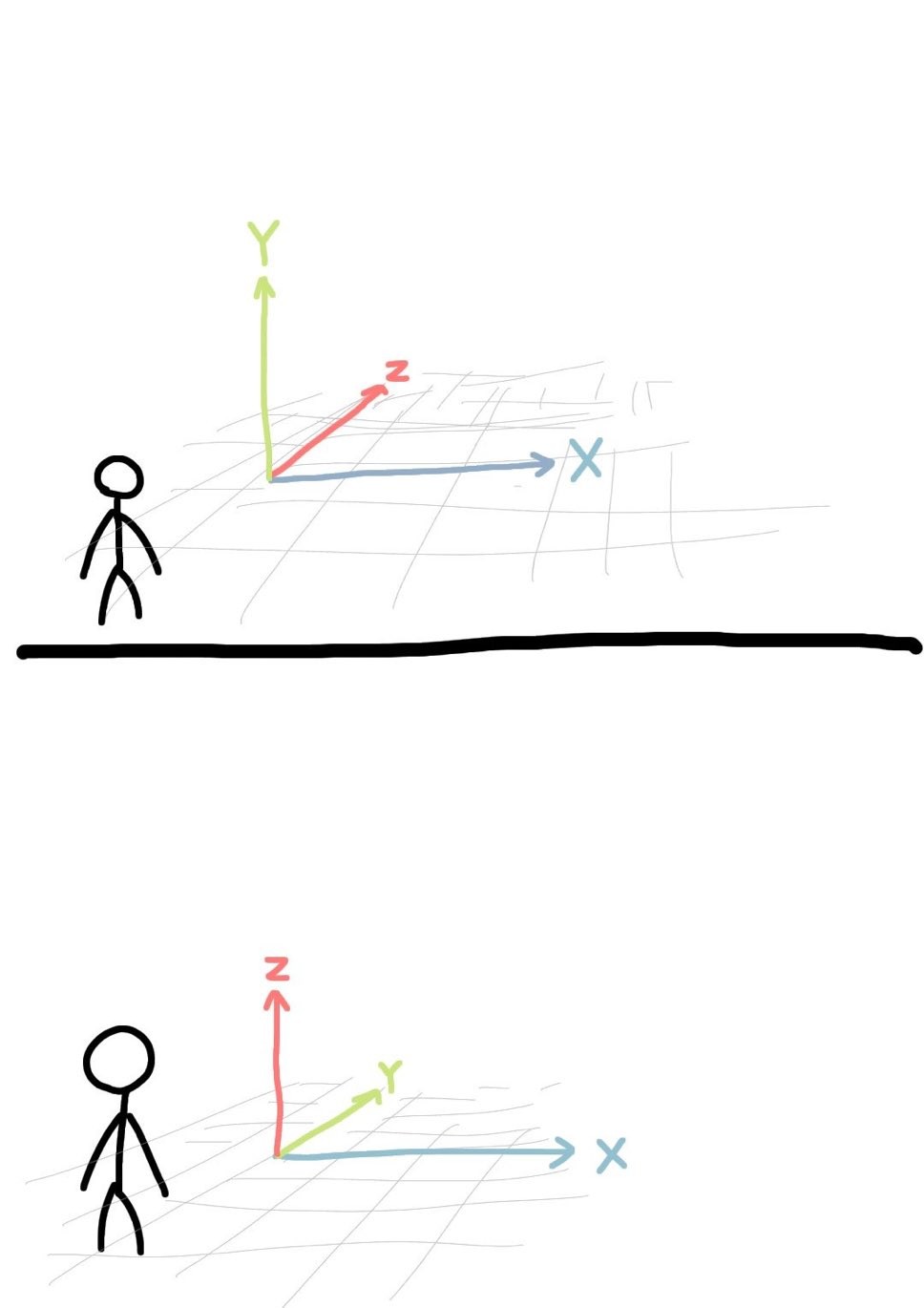
Top one is incorrect. Z needs to point outwards.
There are three kinds of people…
Actually…
unreal georg is an anomaly and should not be counted
deleted by creator
Z up all the way because my 3d printer but why is Minecraft y-up D:
I may be wrong, but I believe mc Java is left handed and bedrock is right handed, both with Y as height
I don’t really play bedrock and on Java I don’t really pay attention to the coords.
Unreal Engine is switching to Y-up
https://x.com/TimSweeneyEpic/status/1930678660098408669
That’s…not the problematic part there, like at all.
There’s a problematic part ?
A left handed coordinate system is absolute blasphemy.
ah ! well. I don’t use any of the programs that are left handed so I can’t say I’ve ever had to struggle with I/O shenanigans, if that’s what you’re talking about. But you’re leaving me guessing, so not sure what else I can say
I spend a lot of time opening files in multiple programs. What would even happen if you switched from a right handed program to a left handed program? It’s completely up to interpretation how to read the orientation.
Thank god, this is the one true coordinate system
Personally I feel limited if I’m working in anything else than a non-euclidean coordinate system
Dwarf Fortress goes with Blender and the others
Also Minecraft in Y-Up
deleted by creator
Tradition, 3d videogames started doing it like that because of how computers worked 40 years ago, then devs got used to think about 3d space that way and it stuck. Essentially videogames think about visual depth. And yes, the physics engines for videogames usually account for that and use their own transformations of formulas because they are rarely simulating anything more complex than rigid body physics. Advanced simulations aren’t any harder for devs, all the transformations are abstracted away with libraries.
In the end they are just reference frames and up is whatever you want it to be. As Wikipedia puts it eloquently: “Unlike most mathematical concepts, the meaning of a right-handed coordinate system cannot be expressed in terms of any mathematical axioms. Rather, the definition depends on chiral phenomena in the physical world, for example the culturally transmitted meaning of right and left hands, a majority human population with dominant right hand, or certain phenomena involving the weak force.”
deleted by creator
Not really. Youtuber Acerola has a great series on shader programming and dealing with negative numbers is a non-factor. The advantage of working with computers is that it abstracts that complexity away. You program with high level concepts, a dev rarely deals with direct calculations, unless they are actually writing the fundamental apis for it, like DX or Vulkan. Much less copy-paste formulas. It gets complicated fast, but the abstraction keeps it simple for the developer, like, the math is perhaps the easiest part of programming computer graphics.
Ace is a decent watch. Shit post quality video energy, that’s information dense. Always gonna second an Acerola suggestion.
deleted by creator
It’s okay. The equations have been done since a long time ago. Devs don’t have to think about it much. Essentially, computer simulations already have their own body of math that you probably were not taught in physics, because they aren’t relevant for real world physics study.
Invalid diagram. FreeCAD demands representation.
I’m not getting left handed vs right handed. Right handed means negative values go right? Why would anyone do that?
Right handed means that when you curl the fingers on your right hand from +X towards +Y, your thumb points towards +Z.
Someone else was explaining how to tell left from right handed. Buy why is it important? If you do math and physics, you almost certainly would use a right hand system. That means all formulas are derived with that in mind. If you try to use them in the left handed system, you are going to have a horrible time trying to figure out which of all terms need to have their sign flipped.
Eh sort of? It’s all a matter of perspective. In Blender which uses a right hand system, when you view from the side, right is positive Y, up is positive Z, and towards the user is positive X.
But looking from above, positive X is right, positive Y is up, and positive Z is towards the camera. Obviously if you rotate the camera to be viewing from the negative side of the axis some directions get flipped.
Basically if you’re axis aligned, things work out the way you would expect.
But then should the little axis depictions in OP be swapped?
Yeah the first one is a left handed coordinate system.
Oh dear Lord.
I know Z as upward. X and Y were always on the base plane representing length and width. Z comes in being all like, “Now we’re being 3D!”
So wherever the “floor” is, represented with gridlines, boundary, canvas, etc. that’s where they live. That is Flatland where there is no up or down. It is 2D where most of my work is. If you try tell me Y is Z, I’d ask “wtf is a Z?”
Only in a top-down perspective. Most screens are vertically oriented though, meaning the reference 2D plane is left-right-up-down.
You’re mixing up perspective with the object’s actual coordinates system. The “left-right-up-down” are your perspective or computer screen and do not define the axes of the object itself. The object has its own.
If I rotate a map on a table, it’s X and Y don’t suddenly flip. The coordinates belong to the object, I’m just viewing them from a different perspective now.
In mathematics, the Z axis only exists because it’s defined as being perpendicular to an existing plane (the plane X and Y form). The gridlines represent that plane and Z’s extrusion values reference it. Your perspective or viewing angle don’t influence these coordinates at all.
Commonly we face the XY plane down as it’s “floor”. We build things from the ground up. We draw from top down. It’s just how gravity brought the standard around. You can flip it however you want, though. But if you see a grid, that’s a plane and Z is extrusion off that.
By your own logic there is no “up”, only x/y/z, so what’s your complaint?
There is NO mathematical or physical reason why XY should be the floor, that is your own bias.
No. That is not my logic. It’s the logic of Rene Descartes who invented the thing you are trying to talk about.
And because gaslighting attempts online are hilarious, I’ll assume you just didn’t read so good and will repeat myself again; we tend to rest the plane on the floor, as it is in our reality with gravity it is easier to conceive. Like modelling a car, it’s wheels on the screen spend most of the time pointed down.
You don’t have to. You can model it any direction you want, but most people find it easy in an orientation that mimics common perspective. But however you do it, you still can’t have a Z axis without a plane. That’s the point. Grid is plane and plane is needed for Z. If you have a grid on Z it’s representing an infinitely possible slice through extrusion and that’s basically a concept behind some fractals, which introduces a new vector for new XYZ points within.
I know you really want to be right but this is very long-standing foundational and basic stuff we just do. It isn’t my logic or opinion, I’m sharing this knowledge to you, something you can very easily look up yourself right now and forget I even exist—which would be neat.
By that logic the only non-arbitrary dimension is defined by gravity, so the primary axis (X) should be up and down.
Math is not rigid like you are saying: 3D coordinates can be oriented in any direction because they are fundamentally arbitrary. A lot of people a damn lot smarter than you have damn good reasons for using different coordinate systems, and they are mathematically correct.
But what if instead of adding a third dimension by going UP, you add a third dimension by going FORWARD. Like a computer screen, X and Y coordinates are side-to-side and up-and-down. If you made a volumetric display by adding a third dimension to that, Y would be up and Z would be forward.
I usually think of Z as up, because that’s how stuff based on the physical world usually works. But I can understand why some think of it with Y as up.
Third dimension isn’t up, it’s just not X or Y. We just say “height” or synonyms for it because we say “length and width” for X and Y, even though all axis are just length between vectors proceeding in order of being able to exist, X, Y, then Z.
If you are plotting your perspective, it will run on entirely different coordinates to an object’s coordinates, i.e. Camera vs Object stricture. But in most arts and all math, we tend to model the object and it’s values which we create and assign to it as attributes, not with values of how it should look from various perspectives.
I think that’s the confusion. You could get used to the Z being treated as Y, but it’s incomparable with everything else and you’d have to now confirm with other’s that length and width are X and Z and extrusions from 2D plane are Y. This doesn’t occur much anywhere else. This is the whole premise behind the meme. Arguing between standards when one is universal, the other is niche but those that have only learned the niche one are adamant the universal one is wrong.
Z always points outwards